What Is a Good Food Cost Percentage for an Indian Restaurant?
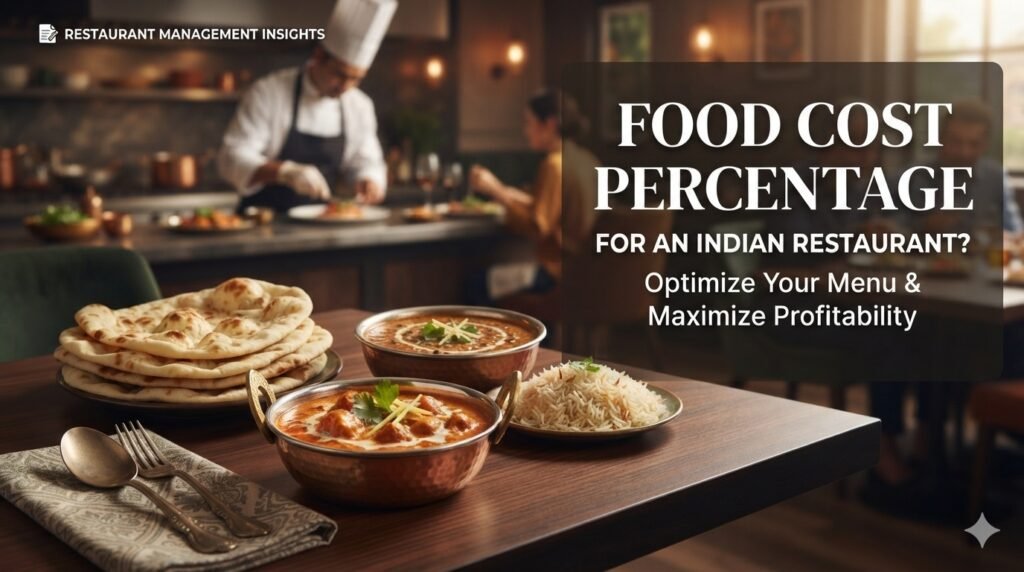
“What’s a good food cost percentage?” is one of the first questions any restaurant owner asks — and one of the most misleading to answer with a single number pulled off a US foodservice blog. Food cost that’s healthy for a quick-service outlet would sink a fine-dining kitchen, and a number that looks fine in isolation can still be a problem once you weigh it against payroll. Here’s what we actually track with clients, by format, and where the real red flags start.
Ideal food cost percentage by restaurant format in India
| Format | Ideal food cost % |
|---|---|
| QSR (quick-service) | ~22% |
| Casual dining | 28–30% |
| Cafe | ~24% |
| Cloud kitchen | 25–30% |
QSR runs leanest because the menu is small, portions are standardised, and purchasing is high-volume and predictable — there’s little room for waste to hide. Casual dining carries a wider band because the menu is broader and portioning is harder to standardise across more dishes and more kitchen staff. Cafes sit lower than casual dining mainly because beverages (coffee, tea) carry very high margins and pull the blended average down even when food items alone cost more. Cloud kitchens run close to casual dining — no dine-in overhead to offset a higher food cost, so the format still needs disciplined portioning and packaging-inclusive costing per dish.
Food cost is only half the picture: prime cost
Food cost in isolation can mislead. A restaurant with 24% food cost but 35% payroll is in worse shape than one running 29% food cost with 18% payroll — which is why we look at prime cost (food cost + labour cost combined) rather than either number alone.
Our benchmark: keep food cost under 29% and payroll under 20% of revenue in metro cities. In tier 2 and tier 3 cities, payroll should stay under 15% — lower cost of living and lower prevailing wages mean a metro-level payroll percentage in a smaller city usually signals overstaffing, not fair pay.
The red flag threshold
If your food cost is crossing 30%, treat it as a signal, not a one-off bad month. In our experience it almost always traces back to one or more of: portion sizes that have crept up (or were never standardised with a recipe card in the first place), wastage during prep or storage, or purchase cost that’s drifted because nobody’s renegotiated with vendors or checked rates against the market recently. All three are fixable within a billing cycle once you know which one it is — the expensive mistake is not tracking closely enough to notice for months.
How to actually bring food cost down
Start with what’s measurable weekly, not what sounds good in theory:
Standardise every recipe. If portion sizes vary by which cook is on shift, your food cost will vary with them. A written recipe card with exact gram weights is the single highest-leverage fix most kitchens haven’t done.
Track wastage separately from purchase cost. A kitchen can buy well and still bleed margin through spoilage, over-prepping, or plate waste that never gets measured because it’s thrown out before anyone looks at it.
Re-check vendor rates on a schedule, not reactively. Ingredient costs move throughout the year; a rate that was competitive six months ago may not be now, and nobody notices unless someone is assigned to check.
Cost every dish at true cost, including packaging for delivery. For cloud kitchens especially, packaging is a real per-order cost that’s easy to leave out of a food-cost calculation — and doing so makes the number look better than the P&L actually is.
A real example: cloud kitchen food cost under 30%
We set up a multi-brand cloud kitchen in Gurgaon and have tracked every cost metric since day one specifically to keep food cost from crossing the 28–30% band. The discipline isn’t a one-time setup — it’s a weekly habit: pull the numbers, flag the outlier dish, fix the recipe or the vendor rate before it compounds across a month of orders.
FAQs
What is a good food cost percentage for a restaurant in India?
It depends on format: roughly 22% for QSR, 28–30% for casual dining, 24% for cafes, and 25–30% for cloud kitchens. Above 30% in most formats is a signal to investigate portioning, wastage, or purchase cost.
What is restaurant prime cost and why does it matter more than food cost alone?
Prime cost is food cost plus labour cost combined, as a percentage of revenue. A restaurant can have an acceptable food cost and still be unprofitable if payroll is too high, so the two need to be read together — not in isolation.
What is a healthy prime cost for an Indian restaurant?
Aim for food cost under 29% and payroll under 20% of revenue in metro cities; in tier 2/3 cities, payroll should stay under 15% given lower prevailing wages.
How do I reduce food cost in my restaurant?
Standardise recipes with exact portion weights, track wastage separately from purchasing, re-check vendor rates on a fixed schedule rather than reactively, and cost every dish at true cost including packaging for delivery orders.
The bottom line
There’s no single “good” food cost number — only a good number for your format, read alongside your payroll. If your numbers are drifting past these benchmarks and you’re not sure which lever to pull first, talk to our cost-control consulting team, or book a free 30-minute consult.
Related Posts
September 11, 2026
रेस्टोरेंट कैसे खोलें (2026): लागत, लाइसेंस और मुनाफ़ा — पूरी गाइड
हर साल भारत में हज़ारों लोग रेस्टोरेंट खोलते हैं। और उनमें से बहुत बड़ी संख्या…
September 4, 2026
Menu Engineering Explained: How to Redesign a Menu That Makes Money
Most restaurant menus are built once, at launch, and then never seriously revisited — new…
September 4, 2026
Restaurant Profit Margins in India: What’s Realistic by Format
“What’s a realistic profit margin for a restaurant in India?” is a question we hear…
September 2, 2026
How Much Does It Cost to Open a Restaurant in India in 2026? (Full INR Breakdown)
A restaurant in India can cost anywhere from ₹5 lakh for a small cloud kitchen…