Menu Engineering Explained: How to Redesign a Menu That Makes Money
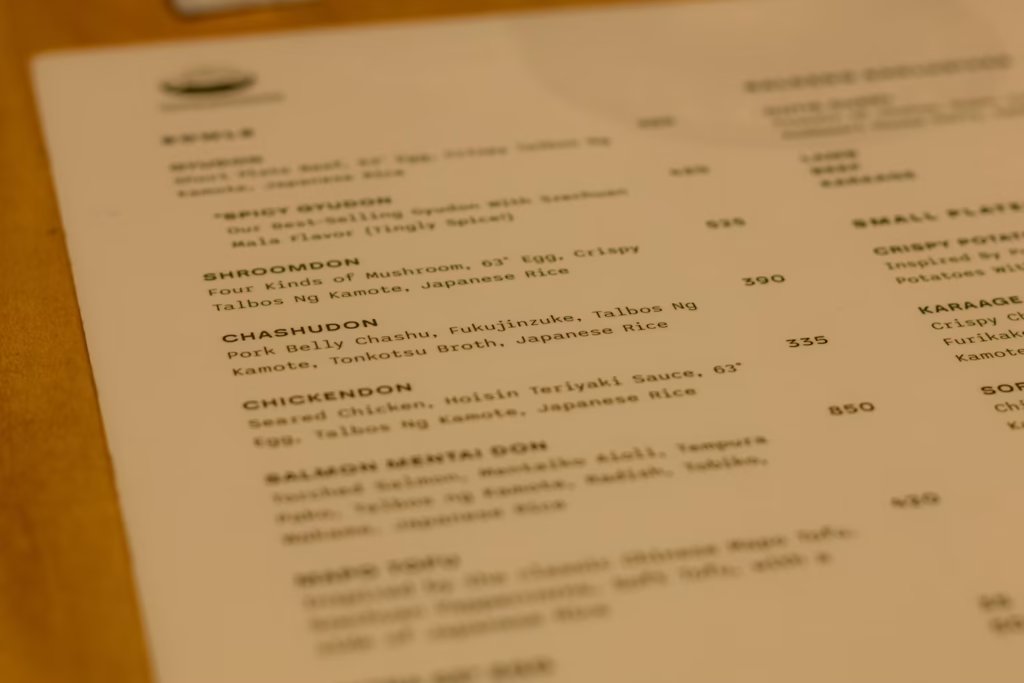
Most restaurant menus are built once, at launch, and then never seriously revisited — new items get bolted on, nothing gets removed, and pricing follows “what feels right” rather than what the numbers say. Menu engineering is the fix: a structured way to look at every dish through two lenses — how much it sells, and how much it actually makes you — and redesign the menu around what that reveals.
What is menu engineering?
Menu engineering is the practice of analysing every dish on your menu against two variables — popularity (how often it sells) and profitability (how much margin it contributes) — and using that analysis to decide what to keep, reprice, redesign, promote, or cut. It replaces gut-feel menu decisions with a repeatable process based on your own sales data.
The menu engineering matrix: four categories
Every dish on your menu falls into one of four categories, based on plotting popularity against profitability:
Stars (high popularity, high profitability). Your best dishes — sell well and make good margin. Protect these: don’t mess with the recipe, keep them prominently placed on the menu, and use them to anchor your identity. These are what you should be known for.
Plowhorses (high popularity, low profitability). Customer favourites that don’t make much money — often a signature dish priced too low, or one with a costly hero ingredient. These need a careful repricing or recipe-cost review rather than removal, since cutting a genuinely popular dish damages customer trust. Small price increases (a customer rarely notices ₹20–30 on a dish they already love) or portion/ingredient adjustments are usually the right lever.
Puzzles (low popularity, high profitability). Dishes that make great margin when ordered, but rarely get ordered — often because of menu placement, unclear naming, or lack of visual appeal in the description. These are your biggest opportunity: better menu placement (upper-right area of a page, where eyes land first), a more appetising description, or highlighting them as a “chef’s recommendation” can shift real revenue toward these without changing the kitchen at all.
Dogs (low popularity, low profitability). Dishes that neither sell nor make money. Cut these — every dog on your menu adds inventory complexity, kitchen SKU count, and menu clutter without contributing anything back. A shorter, more focused menu built from Stars and repositioned Puzzles almost always outperforms a longer one padded with Dogs.
How to run a menu engineering exercise, step by step
1. Pull your sales data by dish, over at least 30-60 days. You need real order volume per item, not a guess — most POS systems export this directly.
2. Calculate contribution margin per dish (selling price minus food cost per plate — not the percentage food cost, the rupee amount each dish actually contributes).
3. Plot every dish against the matrix using your menu’s average popularity and average contribution margin as the two dividing lines — a dish is “high” or “low” relative to your own menu’s averages, not some external benchmark.
4. Assign each dish a category and decide the action: protect Stars, reprice or reformulate Plowhorses, reposition and rename Puzzles, cut Dogs.
5. Redesign the physical/digital menu layout around the results — Stars and repositioned Puzzles in the highest-visibility spots, Dogs removed entirely, Plowhorses re-priced.
6. Re-run the exercise every 6-12 months, or after any significant price or cost change — menu engineering isn’t a one-time fix, it’s a recurring discipline.
A worked example
Take a casual dining restaurant with a butter chicken priced at ₹320 that sells 40 covers a day (clearly popular) but costs ₹140 in ingredients — a contribution margin of ₹180, below the menu’s average. That’s a textbook Plowhorse: hugely popular, but not pulling its weight on margin. Rather than cut it (customers would notice immediately), the fix might be a modest ₹20 price increase, or a small portion adjustment that keeps the dish recognisable while lifting the margin.
Meanwhile, a specialty appetiser priced at ₹280 with a ₹60 food cost — a strong ₹220 contribution margin — might only sell 4 covers a day because it’s buried at the bottom of the menu with a generic one-line description. That’s a Puzzle: moving it to a highlighted position, adding a more appetising description, or having servers mention it as a recommendation could meaningfully lift its order volume without touching the kitchen at all.
Pricing psychology that supports menu engineering
Drop the currency symbol. Menus that show “320” instead of “₹320” measurably reduce price-consciousness in how customers read the menu.
Avoid strict price-descending or price-ascending columns. A menu that visually lines up prices in a column makes it too easy for customers to price-compare and default to the cheapest option — stagger pricing placement instead.
Use anchor pricing. Placing one deliberately expensive item near the top of a section makes everything else look more reasonable by comparison, even if that item rarely sells itself.
Limit choice within each section. Too many options in one category creates decision fatigue and often pushes customers toward the cheapest, safest choice rather than your most profitable one.
FAQs
What is menu engineering?
Menu engineering is the practice of analysing every dish by popularity and profitability, then using that analysis to decide what to keep, reprice, redesign, or remove from the menu.
What are the four categories in the menu engineering matrix?
Stars (high popularity, high profitability), Plowhorses (high popularity, low profitability), Puzzles (low popularity, high profitability), and Dogs (low popularity, low profitability).
How often should I redo my menu engineering analysis?
Every 6-12 months, or any time you make a significant price change or ingredient cost shift — it’s a recurring discipline, not a one-time fix.
How do I price menu items in India?
Price from contribution margin (selling price minus food cost per plate), not just a target food cost percentage — and use menu placement, anchor pricing, and limited choice within each section to guide customers toward your most profitable dishes rather than relying on price alone.
The bottom line
Most menus are full of Dogs nobody’s cut and Puzzles nobody’s noticed, simply because nobody’s run the numbers. A structured menu engineering pass — even a basic one — usually surfaces changes that lift margin without a single new customer walking through the door. If you want a real menu engineering audit for your restaurant, talk to our menu development team, or book a free 30-minute consult.
Related Posts
September 11, 2026
रेस्टोरेंट कैसे खोलें (2026): लागत, लाइसेंस और मुनाफ़ा — पूरी गाइड
हर साल भारत में हज़ारों लोग रेस्टोरेंट खोलते हैं। और उनमें से बहुत बड़ी संख्या…
September 4, 2026
Restaurant Profit Margins in India: What’s Realistic by Format
“What’s a realistic profit margin for a restaurant in India?” is a question we hear…
September 3, 2026
What Is a Good Food Cost Percentage for an Indian Restaurant?
“What’s a good food cost percentage?” is one of the first questions any restaurant owner…
September 2, 2026
How Much Does It Cost to Open a Restaurant in India in 2026? (Full INR Breakdown)
A restaurant in India can cost anywhere from ₹5 lakh for a small cloud kitchen…