Zomato & Swiggy Commission Rates in 2026 — and How to Protect Your Margin
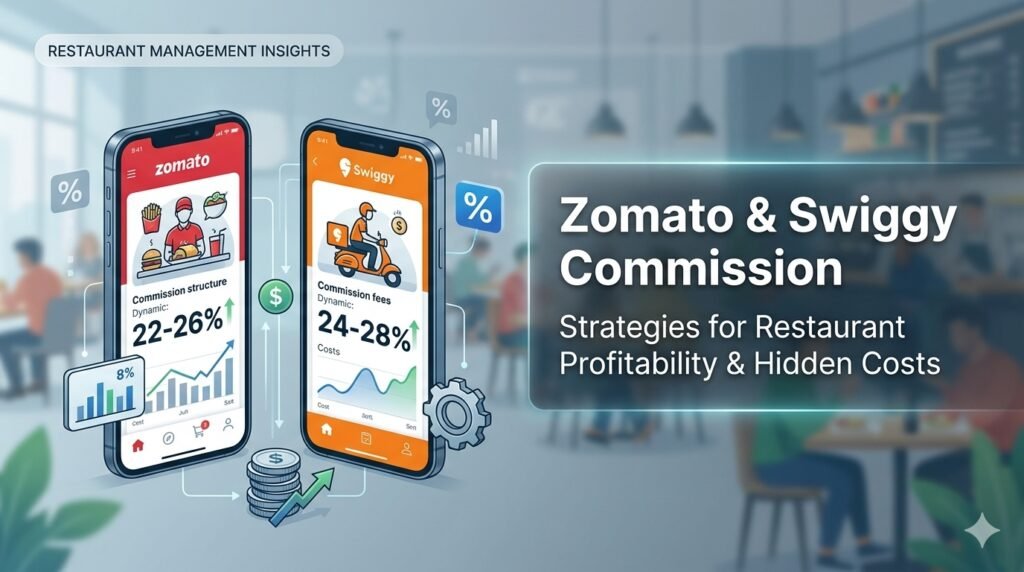
Every restaurant owner doing delivery volume through Zomato and Swiggy asks the same question sooner or later: why does the P&L never quite match the sales dashboard? The answer is almost always commission — and it’s higher, and more layered, than most owners realise until they sit down and actually reconcile a payout statement. Here’s what the commission structure actually looks like in 2026, and the concrete levers we use with clients to protect margin against it.
What commission do Zomato and Swiggy actually charge in 2026?
Commission for a typical single-outlet or small restaurant partner runs 25–27% of order value on both platforms — this is the figure we work with across most of our client base. That number isn’t the whole story, though: it’s charged on the gross order value before taxes and platform fees are netted out, and it sits on top of — not instead of — other deductions that hit the same payout.
The rate isn’t fixed for everyone, either. Restaurants with meaningful scale — roughly 10 or more locations nationally or concentrated in a specific region — have real room to negotiate commission down to the 18–22% range. Both platforms will tell you the standard rate is non-negotiable when you’re a single outlet, but that changes once you bring volume to the table. If you’re operating or planning a multi-location rollout, factor this into your margin projections rather than assuming you’ll pay the standard rate at every outlet indefinitely.
Toing — lower commissions now confirmed by Swiggy itself. Swiggy’s budget format Toing, launched in September 2025, is aimed at students and early jobbers: meals start at ₹49, most sit under ₹250, and there is no delivery fee for the customer. On Swiggy’s Q1 FY27 earnings call in August 2026, Group CEO Sriharsha Majety confirmed the commission structure is deliberately different: “commissions do need to be different from the Swiggy platform to enable our restaurant partners to offer everyday low prices. So it is a core part of the strategy.” Management described Toing’s monetisation as coming from flat consumer fees, higher ad placements and lower restaurant take rates. Zomato’s Deepinder Goyal, arguing against the model, independently described Toing and Rapido’s Ownly as running “lower menu prices funded by lower commissions and delivery fee” — so both sides of the market agree the rate is lower.
But Swiggy has ruled out zero commission on Toing. Majety was explicit that Toing will not go to zero, and Swiggy’s food marketplace CEO Rohit Kapoor called zero-commission “a marketing gimmick”: “If it is zero commission, then who pays for the cost of the platform? Somebody has to pay.” Swiggy has not published an exact Toing commission percentage, and you should not plan on a specific number until it appears in your own partner agreement. What you can reasonably expect is a rate below the 25–27% standard marketplace figure — and if you are being onboarded to Toing, ask for the take rate in writing before you accept the lower menu pricing that comes with it. (Source: Swiggy Q1 FY27 earnings call, 7 August 2026.)
Why your actual take-home is lower than “100% minus commission”
The commission percentage is the headline number, but four other things quietly reduce what actually lands in your bank account:
GST on the commission itself. The aggregator charges GST on top of its commission, which you pay as part of the platform’s invoice to you — it’s a real cost, not a wash, unless you’re claiming full input tax credit and tracking it properly.
Payment gateway charges. A small percentage is deducted for payment processing on every order, regardless of order value.
Discounts and promotions you fund. Platform-run discounts, “flat 50% off” campaigns, and delivery-fee waivers are frequently co-funded by the restaurant, not just the platform — read the terms on every campaign you opt into, because “free” visibility boosts often aren’t free.
Ad spend inside the app. Sponsored placement, “Ads” boosts, and visibility packages are a separate line item from commission entirely, and it’s easy to lose track of how much of it is actually converting to profitable orders versus just volume.
Add these up against a 25–27% headline commission and it’s common for the effective cost of an aggregator order to land meaningfully higher than the commission line alone suggests — which is exactly why reconciling the payout statement against the order dashboard matters more than watching the commission percentage in isolation.
How to reduce your effective Zomato/Swiggy commission
Reconcile every payout statement against your order log. Don’t assume the deduction matches the advertised commission rate — cross-check monthly. Discrepancies are common and often go unnoticed for months because nobody’s assigned to check.
Be deliberate about which campaigns you opt into. Not every visibility boost pays for itself. Track incremental orders from a campaign against what you funded for it before renewing.
Price your delivery menu to absorb commission, not to match your dine-in menu. Many operators run a slightly different price list for delivery specifically to protect margin after the commission cut — done transparently, this is standard practice, not a customer-trust issue.
Push customers toward direct channels where it makes sense. A WhatsApp ordering line, your own website, or a loyalty program for repeat customers reduces your blended commission exposure over time, even if aggregators remain your main volume driver.
Negotiate hard if you have scale. This is the single biggest lever available: restaurants with around 10+ locations (nationally or in a concentrated region) can realistically bring commission down from the standard 25–27% to the 18–22% range. If you’re growing toward that scale, start the negotiation conversation with your account manager well before you hit it — don’t wait for them to offer it.
Track cost per order, not just commission percentage. Once GST, payment gateway fees, ad spend and campaign funding are all in the picture, cost-per-order is a more honest number to manage against than the commission percentage alone.
Should you rely on aggregators or build your own delivery channel?
This isn’t an either/or decision for most restaurants — aggregators bring discovery and volume that’s genuinely hard to replace, especially for a new outlet building an initial customer base. The realistic goal is blending channels: use aggregators for acquisition and volume, and build direct ordering (WhatsApp, your own app or site, phone orders) for your highest-frequency repeat customers, where the full commission cut on every order adds up the fastest.
FAQs
What commission do Zomato and Swiggy charge restaurants in 2026?
Commission typically runs 25–27% of order value for a single-outlet restaurant on both platforms, charged on top of GST, payment gateway fees, and any campaign or ad spend the restaurant opts into. Restaurants with scale — around 10+ locations — can often negotiate this down to 18–22%.
Why is my actual payout lower than expected after Zomato/Swiggy commission?
Beyond the headline commission, GST on the commission itself, payment gateway charges, restaurant-funded discounts and promotions, and in-app ad spend all reduce the final payout — reconcile your payout statement against your order log monthly to see the real number.
How can I reduce my effective commission cost on Zomato and Swiggy?
Reconcile payouts monthly, be selective about which campaigns you fund, price your delivery menu to absorb the commission, build direct ordering channels for repeat customers, and negotiate terms if you have volume leverage.
Should I stop using aggregators and build my own delivery channel instead?
Most restaurants are better off blending both — aggregators for discovery and volume, direct channels for your highest-frequency repeat customers, where commission adds up fastest.
Can restaurants negotiate a lower commission rate with Zomato or Swiggy?
Yes — it isn’t advertised, but restaurants with scale (roughly 10+ locations nationally or in a concentrated region) can often negotiate commission down from the standard 25–27% to 18–22%. It’s rarely offered proactively; you generally have to ask for it as you approach that scale.
The bottom line
Commission is a cost of doing business on these platforms, but it’s not the only cost, and it’s rarely fixed in practice the way the headline percentage suggests. The restaurants protecting margin best are the ones reconciling their payouts monthly and treating cost-per-order, not commission percentage, as the number that matters. If your delivery margins don’t add up the way they should, talk to our aggregator strategy team, or book a free 30-minute consult.
Related Posts
September 2, 2026
Cloud Kitchen Setup Cost in India: Complete 2026 Breakdown
Generic articles quote ₹5–15 lakh for a cloud kitchen because they’re describing a single-brand, bare-minimum…
March 25, 2026
Swiggy Platform Fee Hike
It’s happened again. Just as we were all getting used to the last round of…
March 22, 2026
From Student Mess to ₹10 Crore
The Indian food business is often romanticized, but the reality is that it’s a battlefield…
March 4, 2026
Rapido Ownly Launch
The news is out, and it’s creating quite a buzz in the Indian food and…