Demos
Demos  Colors
  Docs
Docs  Support
Home 15
Newly Added



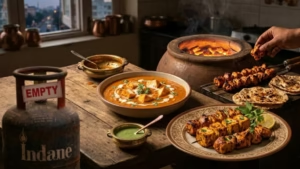
The Indian restaurant industry is known for its resilience, but the past few weeks have tested us in a completely new way. You might have seen the news: shares of food delivery giants like Swiggy and Eternal are in focus, but the real story is happening in our kitchens. A disruption in commercial LPG supply, triggered by the ongoing conflict in West Asia, is forcing restaurants across Mumbai, Delhi, Bengaluru, and beyond to make tough decisions .
lpg
At RestaurantCoach.in, we’ve been fielding frantic calls from restaurant owners watching their gas stocks dwindle while their distributors say “no stock.” It’s a challenging time, but as we always tell our coaching clients, a crisis managed well can become a competitive advantage.
This article isn’t just a summary of the news. It’s your practical playbook. We’ll break down what’s happening, how it impacts your bottom line, and exactly what you need to do to keep serving your customers and protect your profits.
Let’s quickly decode the headlines so you have the full picture. The core issue is geopolitical. The Strait of Hormuz, a critical sea passage through which a significant portion of India’s LPG imports travel, has seen shipping effectively halted due to the Iran conflict . Since India imports a large percentage of its cooking gas, this has created a domino effect right to your restaurant’s doorstep .
Here’s the current situation on the ground, based on reports and our conversations within the industry:
Supply Priority: The government has rightly prioritized domestic (household) LPG cylinders to protect the public. To manage the shortage, commercial supplies are being regulated. Oil marketing companies will now allocate only 20% of the average monthly commercial LPG requirement to restaurants and eateries .
Operational Impact: This isn’t just a minor delay. Reports indicate that up to 50-60% of orders on food delivery platforms have been affected, and some restaurants have been forced to trim menus or temporarily shut down high-gas-usage items like deep-fried dishes or tandoori items .
Government Intervention: The government has invoked the Essential Commodities Act to manage the supply and has even allowed the temporary use of alternative fuels like biomass and kerosene for the hospitality sector to ease the pressure on LPG .
Market Reaction: While UBS maintains a ‘Buy’ rating on Swiggy and Eternal, citing healthy food delivery growth, they have explicitly cautioned that volumes in March and April could face pressure due to this very gas shortage. This tells us that the impact is significant enough to worry global financial analysts [citation:original article].
This isn’t just a supply chain story; it’s a story that hits your revenue, costs, operations, and customer satisfaction all at once. Based on our coaching experience, here are the four critical areas where you’re likely feeling the heat:
1. Menu and Operational Capacity: Your menu is your promise to the customer. When you can’t cook a signature biryani or a popular batch of samosas because they require prolonged high-flame cooking, you’re breaking that promise. The NRAI has even issued an advisory asking members to rationalize menus by temporarily suspending items that require deep frying or slow cooking . This directly impacts your average order value and can turn customers away.
2. Soaring Input Costs: Even if you can find gas, it’s coming at a premium. Reports suggest that the price of a 19-kg commercial cylinder has climbed to between ₹2,100 and ₹2,300, up from roughly ₹1,650 just a month ago . Some private distributors are asking for cash upfront, squeezing your working capital . This directly erodes your already-thin profit margins.
3. Forced Capital Expenditure: To keep the lights on, many restaurants are rushing to buy electric alternatives like induction cooktops, electric griddles, and convection ovens . One restaurant chain founder noted they are “conserving gas and installing induction stoves at certain stores” . This is an unplanned expense that can blow a hole in your monthly budget.
4. Delivery and Cloud Kitchen Disruption: If you run a cloud kitchen or rely heavily on delivery, this is a double whammy. With limited gas, your ability to fulfill orders drops. The Gig Workers Association has already flagged that 50-60% of orders on platforms have been affected, meaning less income for them and less revenue for you [citation:original article]. Unlike a dine-in customer who might understand a temporary shortage, a delivery customer will simply order from somewhere else.
Panic is not a strategy. Here are the concrete steps we are advising our clients at RestaurantCoach.in to take immediately. Don’t wait for things to “get back to normal”—adapt.
1. Immediately Rationalize Your Menu
Action: Audit your menu and identify the top 5 most gas-intensive dishes (e.g., slow-cooked curries, deep-fried items, tandoori dishes). Temporarily suspend them or move them to a “limited availability” section.
Why: This conserves your existing gas stock for faster-moving, essential items. It’s better to serve 80% of your menu perfectly than to run out of gas mid-service.
2. Invest in Hybrid Cooking Equipment (The Electric Shift)
Action: Purchase 2-3 high-power induction cooktops, electric rice cookers, and electric griddles immediately. Don’t wait for the shortage to get worse.
Why: This allows you to switch a portion of your cooking load to electricity . As one Bengaluru restaurateur wisely said, “Even a partial migration of certain cooking processes to electricity can significantly reduce LPG dependency” . It’s an investment in your business continuity.
3. Renegotiate with Suppliers—and Pay on Time
Action: Speak to your LPG distributor every single day. Build a strong relationship. If you have always been a cash-on-delivery customer, ask if a weekly credit line can secure you priority. Be willing to pay a slight premium for assured supply.
Why: In a shortage, distributors will serve the customers who are easiest to do business with. Don’t give them a reason to skip you.
4. Communicate Transparently with Your Customers
Action: Use your social media, table tents, and甚至在 Zomato/Swiggy app to communicate. “Due to the national LPG shortage, we are temporarily unable to serve our famous onion rings. We apologize for the inconvenience and thank you for your support.”
Why: Customers are more understanding than you think, especially when they see news reports about the crisis. Transparency builds trust.
5. Tighten Your Kitchen Operations (Stop the Leaks)
Action: Conduct a “gas audit.” Ensure all pilot flames are off when not in use. Batch cook items during peak hours to avoid reheating. Use lids on every pot to speed up boiling. Check for any gas leaks in your pipelines .
Why: These small operational changes can reduce your total gas consumption by 10-15%, giving you precious extra days of supply.
6. Explore Alternate Fuels (Where Permitted)
Action: For specific high-heat applications like a tandoor or a wood-fired pizza oven, can you source quality charcoal or wood? The government has temporarily relaxed norms for using biomass . A fast-food owner in Hyderabad even created a unique wooden log stove to stay afloat .
Why: This keeps your signature high-value items on the menu without burning through your LPG.
7. Protect Your Margins, Don’t Just Eat the Cost
Action: Calculate the increased cost of goods sold due to higher gas prices and wastage. Consider introducing a temporary “fuel surcharge” on bills (as some restaurants are considering) or slightly increase the price of your remaining items to protect your margin .
Why: Your business needs to survive. Absorbing massive cost hikes is a path to shutting down. A small, transparent adjustment is better than running at a loss.
This crisis has exposed a fundamental vulnerability in how we run our restaurants: single-fuel dependency. For years, we’ve built kitchens entirely around LPG, and now we are seeing how fragile that model can be.
This is a pivotal moment. The restaurant owners who will emerge stronger are not just those who survive the next 30 days, but those who learn the lesson. We need to start thinking about our kitchens as energy-agnostic. The future of the resilient Indian restaurant isn’t purely gas or purely electric; it’s a hybrid model.
This aligns perfectly with the coaching we do at RestaurantCoach.in. We always emphasize the importance of business continuity planning and operational flexibility. Whether it’s diversifying your supplier base, designing a menu with interchangeable cooking methods, or stress-testing your financials for scenarios like this, preparation is key.
Think about it: If you can make your signature dal on a gas stove OR an induction cooktop without compromising taste, you’ve just made your business 100% more resilient. This LPG shortage, as painful as it is, is a wake-up call to future-proof our operations against global shocks.
The LPG shortage is a serious challenge, but it is not an insurmountable one. By acting decisively—rationalizing your menu, investing in electric alternatives, and running a tighter ship—you can navigate this storm.
The key is to act now, not when your last cylinder runs out. Remember, your competitors are facing the same challenges. The ones who adapt fastest will win the customers who are still hungry.
Need expert guidance to navigate these industry changes? Our restaurant coaching programs at RestaurantCoach.in help food entrepreneurs build profitable, sustainable businesses that can withstand any crisis. [Contact us today] to transform your restaurant vision into reality.
Previous Post
Next Post
The Indian food service industry is witnessing a fascinating shift. Homegrown brands are no longer…
The recent buzz around Indiranagar, Bangalore—where several popular cafes are reportedly restricting laptop usage—has sparked…
As a restaurant business coach working with food entrepreneurs across India, I’ve seen a recurring…
The Indian restaurant industry thrives on energy, passion, and a connection with its customers. So,…

Founded in 2015 by seasoned restaurant professionals who understood the challenges faced by food entrepreneurs in India, Restaurant Coach began as a vision to democratize restaurant success.

Founded in 2015 by seasoned restaurant professionals who understood the challenges faced by food entrepreneurs in India, Restaurant Coach began as a vision to democratize restaurant success. After witnessing countless talented chefs and passionate food lovers struggle with business aspects of restaurant operations, our founders decided to bridge the gap between culinary passion and business acumen.