Demos
Demos  Colors
  Docs
Docs  Support
Home 15
Newly Added




As a restaurant business coach working with food entrepreneurs across India, I’ve seen a recurring pattern: the brands that succeed aren’t always the ones with the best food (though that’s a given), but the ones that master the business of delivery. A recent news story about Chandigarh-based Dum Noorani perfectly illustrates this point. The brand reported a staggering fivefold growth in yearly orders after leveraging the Zomato platform.
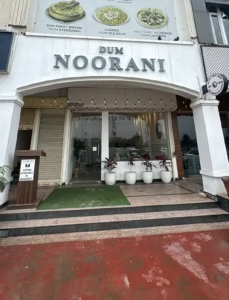
Dum Noorani
But here’s the million-rupee question for you: How did they do it, and can you replicate this success?
At RestaurantCoach.in, we specialize in breaking down these success stories into actionable strategies. Let’s look beyond the headline. This isn’t just about “joining Zomato”; it’s about how a restaurant can use technology, data, and operational discipline to scale from a single takeaway kitchen to 8 outlets.
In this article, we’ll dissect the Dum Noorani case study and give you the blueprint to transform your own restaurant business.
For those who missed the announcement, Dum Noorani, a brand that started as a humble takeaway kitchen in Chandigarh, reported a phenomenal growth trajectory. Their yearly order volume skyrocketed from approximately 12,000 orders in 2019 to over 55,000 orders in 2025.
According to the data, this growth wasn’t an accident. After joining the Zomato platform, the brand utilized several features to optimize their reach. Founder Mannat Singh credits this growth to maintaining authenticity and consistency in royal Indian cuisine while leveraging Zomato to access a wider customer base.
Zomato’s CEO also highlighted the brand’s “unwavering commitment to flavor and consistency,” noting that the growth reflects the trust they built with customers.
But the real story lies in the operational steps they took: they expanded their menu formats (introducing super saver meals, rolls, and party packs), invested in platform visibility tools like Brand Tile and advertisements, and used data insights to identify demand clusters for expansion.
If you run a restaurant in India—whether it’s a cloud kitchen in Gurugram, a QSR in Mumbai, or a fine-dining space in Bangalore—this story validates a critical shift in the industry.
The game has changed. You can no longer afford to view food aggregators like Zomato or Swiggy as just “middlemen taking commissions.” As the Dum Noorani example shows, they are scaling engines.
Here is how this news directly impacts your business strategy:
The “Discovery” Economy: Most customers discover new restaurants via apps now. If you aren’t optimizing your presence there, you are invisible to a massive demographic.
Data-Driven Expansion: Dum Noorani used platform data to identify where to open next. If you are thinking of expanding from one outlet to two, the data sitting in your restaurant dashboard (delivery heat maps) is your best business consultant.
The Consistency Paradox: The CEO mentioned “consistency.” In our coaching practice at RestaurantCoach.in, we emphasize that aggregators are unforgiving. One bad review for consistency can tank your rating. Scaling requires iron-clad Standard Operating Procedures (SOPs).
Menu Engineering: Dum Noorani didn’t just list their existing menu; they created new formats (party packs, super saver meals) based on what the market was asking for. Your online menu cannot be a replica of your dine-in menu.
So, how do you replicate this success? Based on our experience helping restaurants across India optimize their operations, here are five specific actions you need to take:
Dum Noorani grew by joining Zomato. But joining is just the first step.
Action: If you aren’t on aggregators yet, utilize the “do-it-yourself” onboarding systems that take about 15 minutes. Delaying this is leaving money on the table.
Action: Ensure your menu is “digital-first.” High-resolution photos, accurate preparation times, and clear descriptions are non-negotiable.
A key insight from the news was their use of “campaign-based discount strategy aligned with festival demand.”
Action: Stop offering 24/7 discounts. It devalues your brand. Instead, plan promotions around festivals (Diwali, Eid, Pongal) and local events.
Action: Use the platform’s advertising tools (like Brand Tile) strategically. Spend marketing money on days when you have high capacity, not just weekends.
Dum Noorani used platform insights to identify demand clusters. They expanded to 8 outlets because they knew exactly where their customers were coming from.
Action: Log into your aggregator dashboard. Look at the “heat map” of your delivery orders.
Action: If 40% of your orders come from a specific pin code that is currently outside your delivery radius, that is your next potential location for a delivery kitchen.
They introduced “party packs” and “rolls” based on customer demand. This is menu engineering at its finest.
Action: Analyze your customer queries and reviews. Are people asking for family-sized portions? Are they asking for quicker lunch options? Create specific SKUs for these needs.
Action: Introduce a “Value” category. Not every dish needs to be premium. Having a budget-friendly section increases your Average Order Value (AOV) by capturing different customer segments.
The founder’s commitment to “consistency in taste and preparation” was the bedrock of their success.
Action: Create a “Bible” for your kitchen. A recipe book that ensures every chef makes the dish the same way, every time.
Action: Use the “Restaurant Services Hub” offered by platforms to find verified vendors for staffing and hygiene audits. Consistency is hard to maintain when you’re understaffed or failing audits.
In my years of coaching, I often ask owners: Are you building a restaurant, or are you building a food brand?
Dum Noorani built a brand. There is a distinct difference.
Most restaurant owners treat aggregators as a necessary evil. They list their menu, put a 10% discount, and hope for the best. But the brands that win—like Dum Noorani—treat the aggregator platform as a partnership.
At RestaurantCoach.in, we’ve helped dozens of restaurant owners navigate this shift. We emphasize three pillars that Dum Noorani demonstrated:
Operational Scalability: They expanded to 8 outlets without losing quality. This requires replicable processes, not just a “master chef.”
Financial Discipline: They used campaign-based discounts. They didn’t give away profit margins permanently. You must calculate your net margin per order, not just gross sales.
Technology Adoption: They used every tool available—advertising, data analytics, and the Hyperpure supply chain. Many Indian restaurant owners ignore these tools because they seem “complicated.” Ignoring them is the fastest way to fall behind.
Q: I’m a small cloud kitchen in Delhi. Is it worth paying the high commission to aggregators?
A: Yes, but treat the commission as a marketing cost, not a tax. If you aren’t listed, you have zero discovery. Focus on increasing your Average Order Value (AOV) and repeat customer rate to offset the commission costs. Dum Noorani proved that high volumes can offset these costs.
Q: How do I ensure consistency across multiple outlets like Dum Noorani?
A: Standardization is key. Invest in a centralized kitchen (commissary) where raw materials are pre-processed. Use checklists and portion control tools. We cover this in depth in our “Multi-Unit Operations” module at RestaurantCoach.in.
Q: What is the biggest mistake restaurant owners make on delivery platforms?
A: Ignoring the data. Most owners look at the revenue and stop there. You need to look at cancellation rates, prep times, and customer feedback. Dum Noorani succeeded because they used data to expand their menu and their locations.
The story of Dum Noorani is inspiring, but it shouldn’t just be inspiring—it should be instructive. They started as a humble takeaway kitchen and scaled to 8 outlets. The road map is clear: maintain quality, use data to expand, optimize your menu for delivery, and leverage platform tools intelligently.
But knowing what to do and actually implementing it are two different things. Many restaurant owners struggle with the day-to-day execution of these strategies.
Need expert guidance to navigate these industry changes? You don’t have to figure this out alone. Our restaurant coaching programs at RestaurantCoach.in are designed to help food entrepreneurs like you build profitable, sustainable businesses. We help you implement the systems, optimize your delivery strategy, and scale your brand with confidence.
Previous Post
Next Post
The Indian food service industry is witnessing a fascinating shift. Homegrown brands are no longer…
The recent buzz around Indiranagar, Bangalore—where several popular cafes are reportedly restricting laptop usage—has sparked…
The Indian restaurant industry thrives on energy, passion, and a connection with its customers. So,…

Founded in 2015 by seasoned restaurant professionals who understood the challenges faced by food entrepreneurs in India, Restaurant Coach began as a vision to democratize restaurant success.

Founded in 2015 by seasoned restaurant professionals who understood the challenges faced by food entrepreneurs in India, Restaurant Coach began as a vision to democratize restaurant success. After witnessing countless talented chefs and passionate food lovers struggle with business aspects of restaurant operations, our founders decided to bridge the gap between culinary passion and business acumen.