Demos
Demos  Colors
  Docs
Docs  Support
Home 15
Newly Added




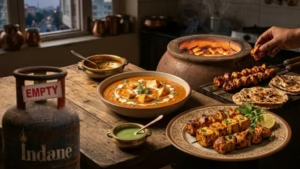
The last few days have been tough. You might have already felt it—a sudden dip in your Zomato and Swiggy orders, suppliers unable to deliver commercial gas cylinders, or the painful decision to take beloved slow-cooked dishes off your menu. If you’re running a restaurant, cafe, or cloud kitchen in India right now, you are likely staring at an empty cylinder and a pile of bills.
lpg
The news is stark. With the ongoing Middle East conflict disrupting LPG shipments through the Strait of Hormuz, India—the world’s second-largest importer of LPG—is facing a severe commercial gas shortage . Industry bodies in Mumbai, Bengaluru, and Chennai warn that up to 50% of restaurants could shut temporarily . For delivery partners on Swiggy and Zomato, orders have plummeted by 50-60%, a clear signal that kitchens are either shut or running at minimal capacity .
But as a restaurant business coach, I’m not here to just deliver bad news. At RestaurantCoach.in, we’ve guided dozens of owners through the COVID-19 lockdowns, the platform commission wars, and now this energy crisis. We see challenges as a call to innovate. This article is your practical, no-panic guide to navigating the LPG shortage, protecting your profits, and future-proofing your business against the next disruption.
To find a solution, we must first accept the reality of the situation. This isn’t a supply chain hiccup; it’s a geopolitical shockwave. The Strait of Hormuz, through which a massive chunk of our energy imports flow, is effectively a high-risk zone right now . The government has rightly prioritized domestic cylinders for households, which means the commercial supply line has been squeezed .
Here’s what this looks like on the ground for restaurant owners:
Skyrocketing Costs & Black Markets: In cities like Mumbai, desperate owners are paying a premium of Rs. 2,000–3,500 for a commercial cylinder that used to cost Rs. 1,750—if they can find one at all . Small roadside stalls are risking penalties by illegally using subsidized domestic cylinders.
The NRAI Advisory: The National Restaurant Association of India (NRAI) has issued a clear advisory: rationalize menus immediately. They are asking members to prioritize dishes with shorter cooking cycles, disable pilot flames, and even consider suspending deep-fried or slow-cooked items .
Platform Panic: When restaurants shut or limit operations, the effect ripples out. Delivery gig workers are seeing their daily orders drop from 30 to just 5-10 . For you, this means relying solely on Zomato and Swiggy is now a high-risk strategy. If you can’t cook, they can’t deliver.
This is more than just a temporary hassle. This crisis exposes the fundamental vulnerabilities in your business model. Let’s break down the specific impacts on different types of food businesses:
For QSRs and Dhabas: Your business model relies on high-volume, fast cooking. If you run a tandoori joint or a deep-fried snack counter, your gas consumption is massive. Without supply, you face an immediate shutdown or a drastic reduction in your best-selling items.
For Cloud Kitchens: You are entirely dependent on aggregator platforms for visibility. If your kitchen is dark, you don’t just lose today’s sales—you lose your ranking on the app, and it takes weeks to recover. The 50-60% drop in platform orders directly hits your revenue, but your rent and staff costs remain fixed .
For Fine Dining: Your identity is built on complex, slow-cooked curries and biryanis. Removing these from the menu isn’t just a logistical issue; it’s a brand identity crisis. Customers come to you for an experience, and a “limited menu” can dilute that experience.
The Financial Squeeze: Even if you find gas, it’s on the black market at inflated prices. This crushes your already thin margins. We’ve seen owners raise thali prices by 10% just to cover the cost of a single cylinder .
Panic never filled a plate. Strategy does. Based on the NRAI guidelines and our coaching experience at RestaurantCoach.in, here are 7 immediate, actionable steps you can take right now.
Don’t wait until your last cylinder runs out. Take action today.
Audit your gas usage: Identify which dishes are gas-guzzlers (slow curries, deep-fried items, tandoori rotis).
Create a “Crisis Menu”: Temporarily remove high-gas items. Promote dishes that are boiled, steamed, or require minimal flame (e.g., rice-based bowls, grilled sandwiches, salads, cold appetizers) .
Batch Cooking: If you must cook a slow item, do it in large batches during off-peak hours to maximize the utility of a single flame.
The surge in shares of companies like TTK Prestige and Stove Kraft tells you everything you need to know about where the market is heading .
Invest in Induction Cooktops: They are incredibly efficient for gravies and boiling. An induction stove can be a lifesaver when your LPG runs out mid-service.
Electric Fryers and Ovens: If you have the capacity, switch your frying and baking to electric equipment. It reduces your LPG dependency significantly.
Action Step: Order induction cooktops today. Quick commerce platforms are selling out fast, so act now .
This is free gas waiting to be saved.
Conduct a walkthrough of your kitchen right now. Are pilot lights burning on idle equipment? Turn them off.
Consolidate your prep and cooking schedules. Instead of having three burners on low for an hour, do the task in 20 minutes on high and turn the gas off.
Use lids and pressure cookers to reduce cooking time .
If a customer walks in and their favorite dish isn’t available, they get disappointed. If you tell them why and show them you’re adapting, they become loyal.
Put up a small sign: “Due to the national LPG situation, we are focusing on our delicious [Alternative Dish] to keep serving you fresh food. Thank you for your support.”
Use your Instagram and WhatsApp status to update customers on your operational hours and menu changes.
The 50-60% drop in Zomato/Swiggy orders is a warning shot . If you’re 80% dependent on them, you’re not a restaurant owner; you’re a vendor for a tech company.
Build Your Database: Even during this crisis, try to capture customer phone numbers. Offer a small discount on their next “direct” visit if they order via your phone or WhatsApp next time.
Promote Takeaway: If your dine-in is slow due to the menu changes, push takeaway orders where you don’t have to pay a 30% commission.
If you run a small chain or cloud kitchen, consider a central kitchen model temporarily. Cooking in bulk at one location and distributing to satellite kitchens saves massive amounts of fuel compared to running full burners at every outlet .
This crisis will impact your margins. Don’t wait for the bank statement to shock you.
Renegotiate rent: If you’re operating at reduced capacity, have an honest conversation with your landlord.
Staff scheduling: If you’re closing early or opening late, adjust staff rosters to save on labor costs without firing anyone.
As a restaurant coach, I see a pattern. The businesses that survive shocks—whether it’s a pandemic or a gas shortage—are the ones that are systematized, not just passionate.
This crisis is highlighting a massive flaw in the Indian restaurant ecosystem: over-reliance on a single fuel source and single revenue channel.
In our coaching programs at RestaurantCoach.in, we always emphasize the “3-Legged Stool” of a resilient restaurant:
Operational Flexibility: Can you change your menu overnight? Do you have SOPs for an emergency? The ones who adapted quickly by switching to induction or rationalizing menus will save their month.
Financial Buffer: Do you have a contingency fund for times like this? Even a small fund of 15 days’ operating expenses can be the difference between shutting down and pivoting.
Direct Customer Connect: If you have a strong WhatsApp broadcast list or an email list, you can tell your customers exactly where you are and what you’re serving, bypassing the aggregators entirely.
Think of this LPG shortage as a stress test for your business. Passing it requires you to be proactive, not reactive.
The LPG shortage is real, and the next few weeks might be bumpy. Restaurants across Mumbai, Delhi, and Bangalore are feeling the heat. But remember, the Indian food industry is incredibly resilient. We’ve faced challenges before, and we’ve always found a way to keep the kitchen fires burning—sometimes with a different kind of fuel.
By taking immediate action—switching to electric, optimizing your menu, and communicating with your customers—you can not only survive this crisis but come out of it with a leaner, smarter operation.
Need expert guidance to navigate these industry changes? Our restaurant coaching programs at RestaurantCoach.in help food entrepreneurs build profitable, sustainable businesses that can withstand any shock. [Contact us today] for a free consultation and let’s build your restaurant’s resilience together.
Previous Post
The Indian food service industry is witnessing a fascinating shift. Homegrown brands are no longer…
The recent buzz around Indiranagar, Bangalore—where several popular cafes are reportedly restricting laptop usage—has sparked…
As a restaurant business coach working with food entrepreneurs across India, I’ve seen a recurring…

Founded in 2015 by seasoned restaurant professionals who understood the challenges faced by food entrepreneurs in India, Restaurant Coach began as a vision to democratize restaurant success.

Founded in 2015 by seasoned restaurant professionals who understood the challenges faced by food entrepreneurs in India, Restaurant Coach began as a vision to democratize restaurant success. After witnessing countless talented chefs and passionate food lovers struggle with business aspects of restaurant operations, our founders decided to bridge the gap between culinary passion and business acumen.