Demos
Demos  Colors
  Docs
Docs  Support
Home 15
Newly Added




At its core, Deepinder Goyal’s public message on X was an exercise in reflective leadership. He directly addressed former Zomato employees, stating, “I know that for many of you, Zomato didn’t have the environment, or the leadership you needed at the time”. This rare admission from a high-profile founder does two powerful things: it validates the experiences of those who left and signals that the company culture has actively worked to improve.
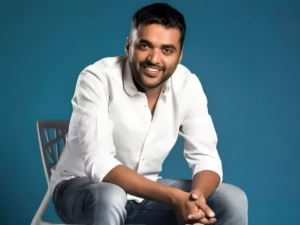
deepinder goyal
The message revealed key data: over 400 people at Eternal are currently in their second or third stint with the company. Goyal argued that these returning employees are often doing their “best work,” benefiting from both their personal growth and the company’s evolution. This underscores a critical business truth: experienced talent who already understand your brand’s core values and operations are immensely valuable. They reduce training time, accelerate productivity, and can become powerful cultural ambassadors.
The outreach was framed not as an act of desperation but as a strategic move to build “a family of companies”—including Zomato, Blinkit, and Hyperpure—that needs people who “already know what good looks like”. For restaurant owners, the takeaway is clear. Your best future team member might not be a stranger from a job portal but a former star server, a skilled sous-chef, or a manager who left on good terms but now has new skills and perspective.
Why should a cafe owner in Bangalore or a cloud kitchen operator in Delhi care about the internal HR strategy of a tech giant? Because the core challenges are identical, just on a different scale. The restaurant industry is one of India’s largest employers but also faces one of its highest failure rates, with studies suggesting up to 73% of restaurants struggle to survive. A significant driver of this is the crippling cost of constant staff turnover.
Financial Drain: Constantly recruiting, hiring, and training new staff is expensive. It diverts funds from marketing, menu development, and customer experience.
Service Inconsistency: Your regular guests come for a reliable experience. High turnover leads to unpredictable service and food quality, directly damaging your reputation and customer loyalty.
Managerial Burnout: Owners and general managers spend disproportionate time on hiring and basic training instead of strategic growth, leading to fatigue and lost opportunities.
Goyal’s strategy highlights the untapped potential of re-hiring. A former employee who returns brings:
Faster Onboarding: They already know your systems, menu, and culture.
Proven Cultural Fit: You already know their work ethic and how they gel with the team.
Enhanced Loyalty: An employee who chooses to return often shows deeper commitment and can become a long-term pillar of your business.
In an industry where, post-pandemic, 61% of diners have noted a decline in service quality, building a stable, skilled, and motivated team isn’t just an operational goal—it’s your most critical competitive advantage.
Watching a billionaire founder’s strategy is one thing; implementing it in your restaurant is another. Here is a practical, step-by-step guide to apply these lessons.
When an employee leaves, move beyond a formal exit interview. Have a sincere, off-the-record conversation. Ask:
What did we do well?
Where did we fall short as leaders or as a workplace?
Would you ever consider returning under different circumstances?
Action: Document these insights (anonymously) and review them quarterly to identify patterns and areas for genuine improvement.
Don’t let former employees disappear. Create a simple WhatsApp group or a monthly email newsletter for alumni.
Share updates about new menu launches, renovations, or team achievements.
Invite them to special staff alumni events or tastings.
This keeps your restaurant top-of-mind and maintains a warm connection, making a return conversation natural in the future.
At RestaurantCoach.in, we advise clients to have a clear policy for re-hiring. This removes awkwardness and shows you value past contributions.
State that former employees in good standing are always welcome to apply.
Define a streamlined re-onboarding process that acknowledges their previous tenure.
Consider recognizing their prior service in seniority or leave benefits.
Often, people leave managers, not companies. Goyal admitted past leadership failures. Empower your head chef, floor manager, and supervisors with basic leadership and communication training.
Action: Dedicate a small budget to training. This single investment can have a greater impact on retention than incremental pay raises alone.
Your workplace must evolve just like your menu. The modern Indian diner in 2026 seeks authenticity, wellness, and experience. Your staff does too.
Embrace Regional & Conscious Menus: Involve your kitchen team in creating dishes with local, sustainable ingredients. Pride in the product boosts morale.
Focus on Experience Economy: Train your staff not just to serve but to curate experiences—telling the story behind a dish, recommending perfect pairings.
Technology should make your team’s life easier, not threaten their jobs. Implement tools that reduce friction:
Cloud-based POS & Inventory Systems: Simplify tedious tasks, reduce errors, and give managers real-time data.
Staff Feedback Apps: Use anonymous digital tools for continuous feedback, giving employees a voice.
Start tracking:
Employee Turnover Rate: Calculate it monthly.
Average Tenure: Is it increasing?
Return Rate: How many former employees are re-applying?
What gets measured gets managed. Setting goals around these metrics focuses your efforts on building a sustainable team.
From our coaching experience at RestaurantCoach.in, this news underscores a fundamental shift in successful business philosophy. For years, the restaurant industry has operated on a transactional model with staff. Goyal’s move reflects a mature, long-term asset-based model. He isn’t just filling vacancies; he’s strategically recruiting institutional memory and reinforced loyalty.
This aligns perfectly with the dominant 2026 trend of “clarity, context, and consciousness” in Indian dining. Today’s consumer seeks authentic, meaningful experiences, which can only be delivered by a team that is stable, trained, and genuinely engaged. A chaotic, high-turnover back-of-house cannot consistently plate the “provenance-based luxury” that defines modern premium dining.
Furthermore, as the market expands beyond metros into Tier 2 and 3 cities, standardized processes and strong culture become your scalable foundation. A team member who has grown with you and believes in your vision is infinitely more valuable in a new location than a completely new hire. They become custodians of your brand’s soul.
Deepinder Goyal’s public call to former employees is more than a PR story. It is a case study in evolved leadership, cultural confidence, and strategic talent management. For the Indian restaurant owner, the lesson is powerful: the people who leave your restaurant don’t have to be lost assets. They can become part of a valuable talent ecosystem you nurture.
By conducting empathetic exit audits, maintaining warm alumni connections, and most importantly, continuously improving your workplace culture and leadership, you build a restaurant that people are proud to be part of—and might choose to return to. In a market where 73% of restaurants face failure, your ability to attract and retain great people is what will place you in the successful 27%.
Need expert guidance to build a restaurant that attracts and retains top talent? Our tailored coaching programs at RestaurantCoach.in help Indian food entrepreneurs like you create profitable, sustainable, and people-first businesses. Contact us today to transform your operational challenges into your greatest competitive advantage.
Q1: Is it really worth the effort to try and get former employees back?
Absolutely. The cost of recruiting and training a completely new employee is significant. A “boomerang employee” ramps up faster, reduces training costs, and often returns with new skills and heightened loyalty, making them a high-value hire.
Q2: What if an employee left on bad terms?
Goyal’s message specifically included those who were “asked to leave”. The key is maturity and growth—from both parties. If sufficient time has passed and you believe the core reason for the issue (often skills or attitude) has been resolved, a conversation can be worthwhile. However, this should be evaluated on a case-by-case basis with clear boundaries.
Q3: How can I improve my restaurant culture to prevent burnout and turnover?
Start with clear communication, fair scheduling, recognizing good work publicly, and investing in basic training. Empower your team with the right tools (like efficient POS systems) and involve them in small decisions, such as contributing to a specials menu. A sense of ownership is a powerful motivator.
Q4: Our margins are tight. How can we afford better retention strategies?
View retention not as a cost, but as an investment. The money saved from constant recruiting, reduced waste from better-trained staff, and increased revenue from consistent, excellent service directly improve your bottom line. Start with low-cost, high-impact actions like genuine recognition and career path conversations.
Previous Post
Next Post
It’s happened again. Just as we were all getting used to the last round of…
The Indian food business is often romanticized, but the reality is that it’s a battlefield…
The news is out, and it’s creating quite a buzz in the Indian food and…
Swiggy vs Zomato Q3 Results: What It Means for Restaurant Owners The latest quarterly results…

Founded in 2015 by seasoned restaurant professionals who understood the challenges faced by food entrepreneurs in India, Restaurant Coach began as a vision to democratize restaurant success.

Founded in 2015 by seasoned restaurant professionals who understood the challenges faced by food entrepreneurs in India, Restaurant Coach began as a vision to democratize restaurant success. After witnessing countless talented chefs and passionate food lovers struggle with business aspects of restaurant operations, our founders decided to bridge the gap between culinary passion and business acumen.